Content Types
Everything you create in the portal is a piece of content of a given type. This page describes each type: what it shows, what it reads, and when to reach for it.
The types available in your instance, their names, their categories, and their order in the create menu are configuration, not fixed behaviour. An administrator can rename a type, move it, reorder it, or switch it off. This page describes a default installation.

What every type has in common
Content reads live records. A piece of content stores what it is pointed at and how it should be presented, not a copy of the data. Reopening it re-reads the records, so it reflects the instance as it is now rather than as it was when the content was saved. Deleting content never deletes the records behind it.
Content is built from your records. Types that show records let you add them from a search, from another piece of content, or from a related list, and the same record can appear in as many pieces of content as you need.
Content is saved to My Space. Until you save it, a tab is working state. Once saved it can be organised into folders, shared, linked to, and reopened.
Plan
Content for laying out intent over time.
Use Case
The anchor for a piece of work. Frames the question, hosts the artifacts created while answering it, and stays open so there is always a way back.
Roadmap
A time-phased plan. Records are placed on a quarter and phase timeline read live from their lifecycles.
Scenario
A what-if member set. Records can be marked as added, removed, or modified, with target dates and measure baselines, without touching the live records.
Scenario Comparison
Two or more scenarios side by side, compared on cost, risk, value, and speed.
Journey Map
A stage by row canvas for mapping a journey across phases.
Analyze
Content for positioning records against each other.
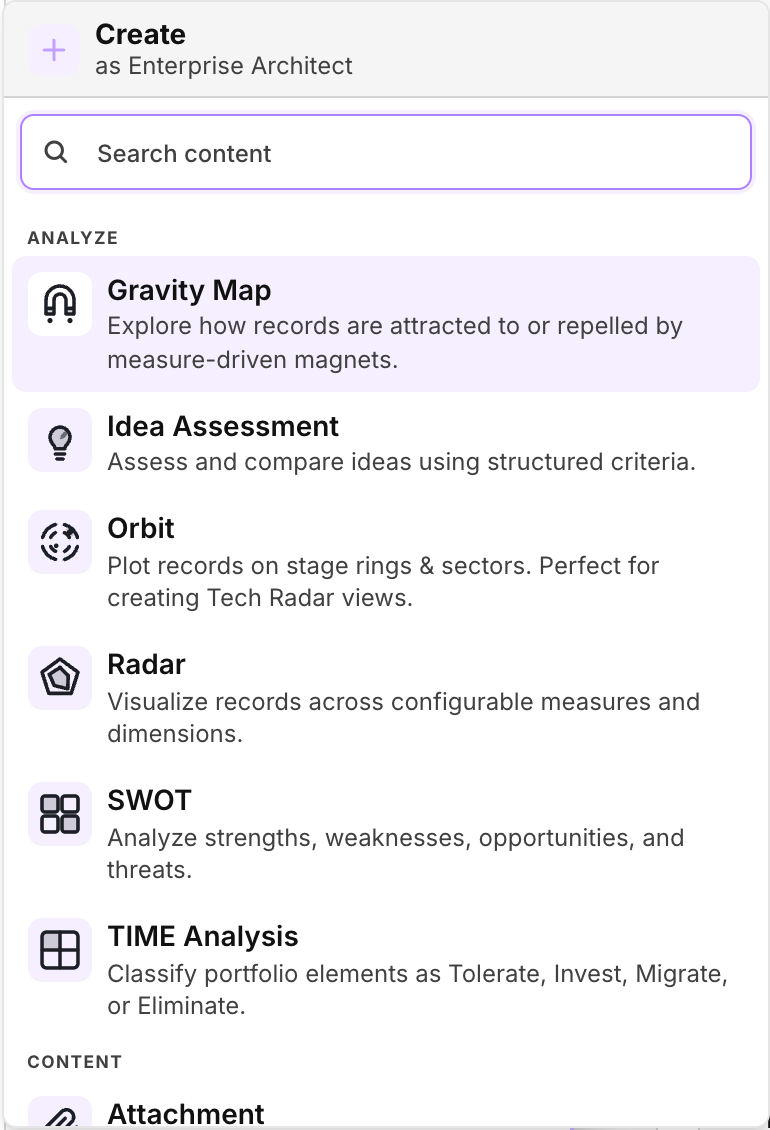
TIME Analysis
The Gartner TIME quadrant: Tolerate, Invest, Migrate, Eliminate, placed on business fit against technical fit.
Radar
A spider chart across several criteria at once. The axes are measures, so every axis is a governed number.
Orbit
A technology-radar view: rings by stage, sectors by category. Rings can come from TIME, a lifecycle, or a banded measure; sectors from a table, a choice field, or a reference rolled up to its top-level parent.
SWOT
A strengths, weaknesses, opportunities and threats matrix. Each quadrant is rich text, and records can be dropped inline as chips.
Gravity Map
A canvas where records are bubbles pulled by field magnets bound to measures. Useful for seeing clustering that a table hides.
Idea Assessment
Scoring and evaluating ideas captured in the Ideation Portal.
Visualize
Content for showing structure and relationships.
Dashboard
A drag-and-resize widget grid. Widgets hold charts, KPIs, measures, record sets, and other saved content. Only the layout and configuration are stored; every widget fetches live.
Hierarchy Map
A tree, landscape, capability, or process map. Parent and child placements are saved as pointers to records.
Dependency Map
An interdependency cascade from one or more starting records, following CI relationships, many-to-many links, and references. Used to see the blast radius of an outage or a retirement before committing to it.
Record Views
Content for working with records directly.
Table
A filterable, groupable, sortable table over a live record set.
Static List
A curated, fixed set of records, with no live query behind it. Use it when the membership is the point and should not change on its own.
Form
A live record editor bound to one record. Saves back to the real record, with a layout that can vary by object type and persona.
Content
Content for the material around the analysis.
Note
Free-form rich text. Records can be dropped inline as chips, so a note can reference real things rather than naming them in prose.
Attachment
A single uploaded file held on the item.
Hyperlink
An external URL, opened either embedded or in a new tab.
Inventory
Structure, and content produced for you.
Advisory Report
A board-ready answer to a governed question, generated by Transformation OS™. Only the question and its evidence plan are stored, so reopening the report re-runs the reads rather than showing a stale conclusion. Covered in the Transformation OS section.
Folder
Organises My Space. Sharing a folder shares everything beneath it.
Shortcut
Points at content held elsewhere, so one piece of content can appear in more than one place without being copied.
Related
The Portal for how content, My Space, and personas fit together.
Personas for controlling which types appear in the create menu.
Hierarchy Map for the map in depth.
Scenarios for scenario planning in depth.
Last updated